> For the complete documentation index, see [llms.txt](https://docs.tricloudnexus.io/llms.txt). Markdown versions of documentation pages are available by appending `.md` to page URLs; this page is available as [Markdown](https://docs.tricloudnexus.io/management-portal/management/update-center.md).
# Update Center
The **Update Center** allows you to update large numbers of devices in one place—by changing either **module versions** or **application versions**. It’s built for safe, predictable, and traceable rollouts, so you don’t have to manage updates device by device.
### Available Updates tab
The **Available Updates** tab gives you a complete list of updates that are ready to be deployed:
* **Modules**\
Shows all modules that are either configured or deployed to devices, where a **newer version** is available. This includes modules installed directly, included through **applications**, or delivered via assigned **asset hierarchies**.
* **Applications**\
Lists all applications configured or deployed to devices, where a **newer version** exists.
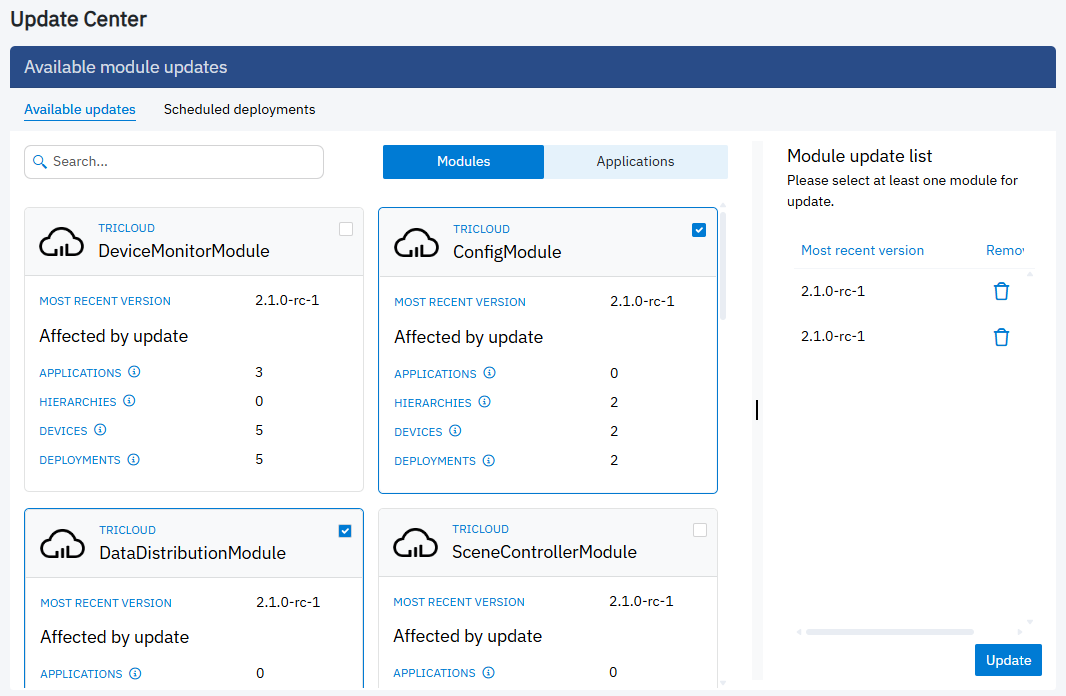
Within the **Update Center**, the **Available Updates** tab is divided into two views: **Modules** and **Applications**. Use the buttons near the top of the page to switch between them:
Update Center showing available module updates
Available module updates are shown as cards, where each card provides the following information:
* Module name and targeted version
* Affected by update:
* **Application**: The number of applications that will be affected by this update, and updated to include the target version of the selected module.
* **Hierarchies**: Asset Hierarchies that will be affected by the update, and updated to include the target version of the selected module.
* **Devices**: The total number of devices where an older version of the targeted module is **configured**.
* **Deployments**: The total number of devices where an earlier version of the targeted module is **deployed**.
You can use **search** field to quickly find the update you’re looking for.
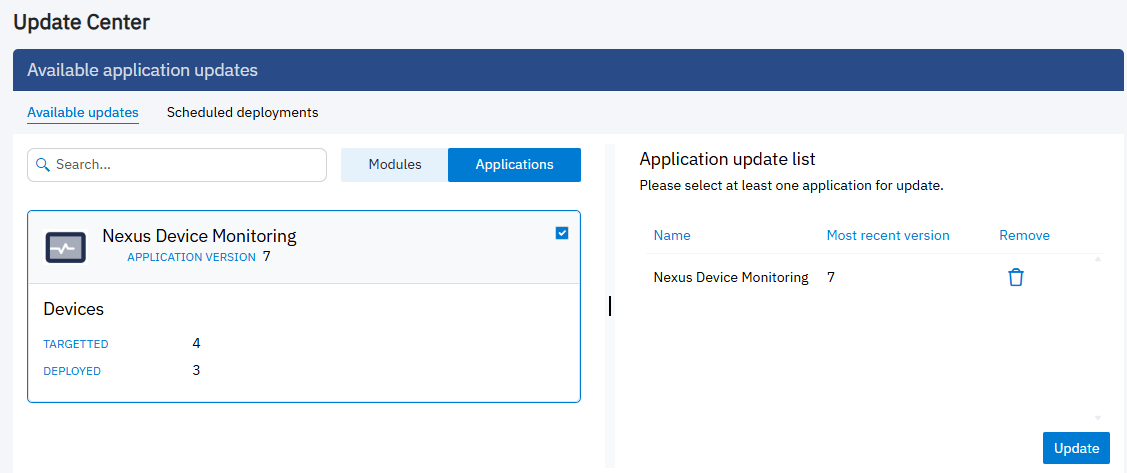
Likewise, an example of the available Application updates can be seen on the screenshot below:
Update Center showing available application updates
The cards showing available application updates include the following information:
* Application name and targeted version
* Affected by the update:
* **Targeted**: Number of devices where an earlier version of the application is configured.
* **Deployed**: Number of devices where an earlier version of the application is deployed.
### Performing Update
Once you've selected the modules or applications you want to update, start the rollout by clicking the **Update** button in the lower-right corner of the screen.
The next steps depend on whether you're updating **modules** or **applications**:
* For details on updating modules, see: \[[Module update documentation](/management-portal/management/update-center/updating-modules.md)]
* For details on updating applications, see: \[[Application update documentation](/management-portal/management/update-center/updating-applications.md)]
Each update path guides you through previewing affected entities, configuring rollout options (such as scheduling), and monitoring progress.